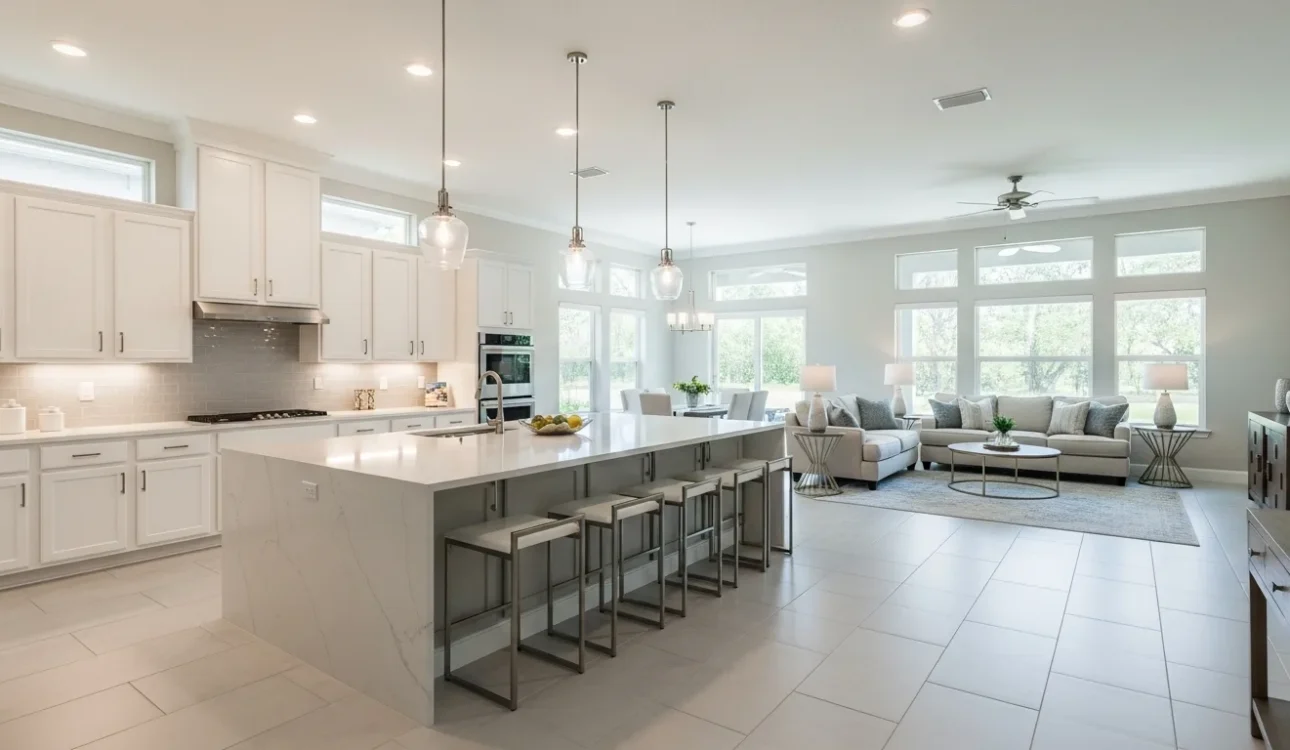
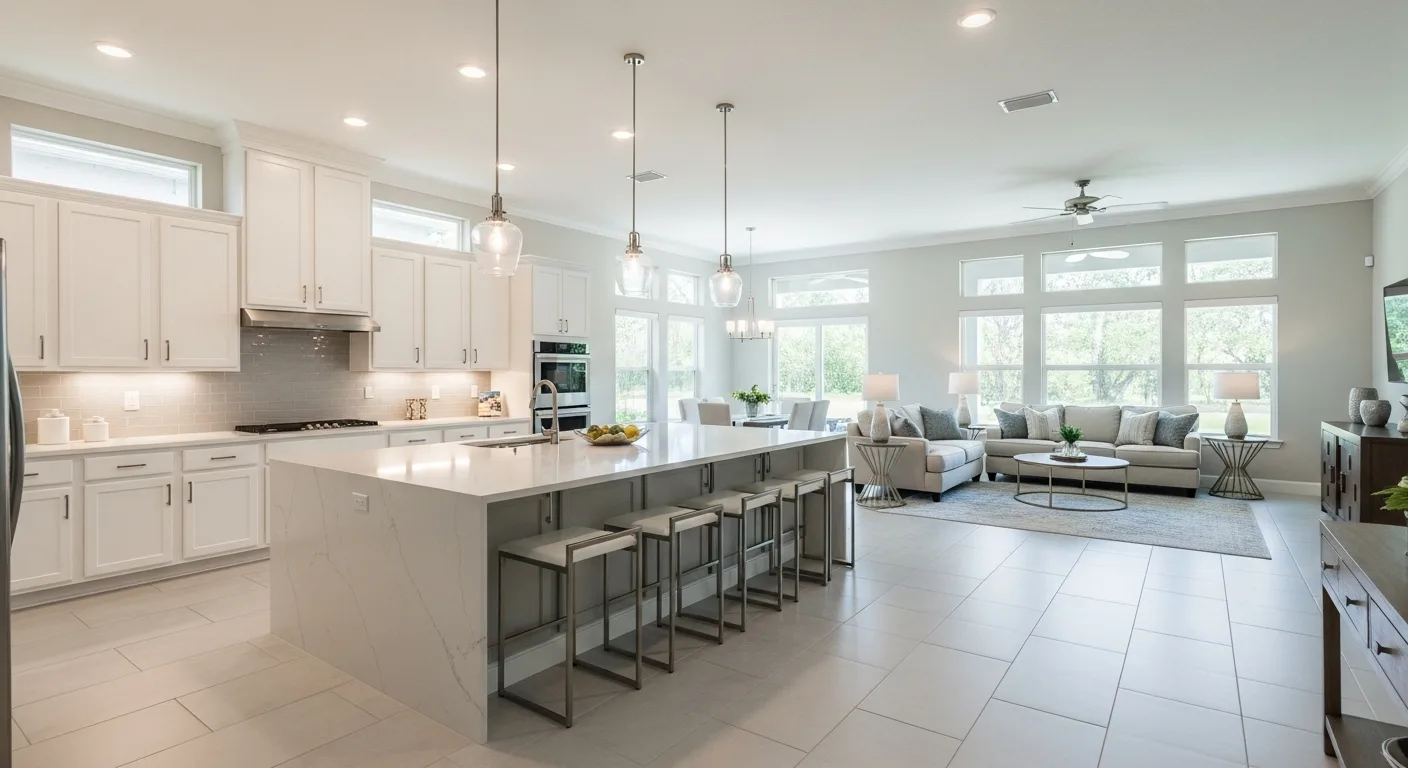
The most common request we hear from Florida homeowners walking into a consultation: “We want to open up the kitchen.” It sounds simple. Remove a wall, push the space into the living room, and suddenly the house breathes differently. But the process — permits, structural engineering, load-bearing walls, HVAC, lighting, and flooring across a newly unified space — raises questions that most renovation websites don’t answer directly.
This guide answers them. Every section below addresses a specific question Florida homeowners ask during the planning phase of an open concept kitchen remodel — with real specs, real costs, and the practical details that determine whether the project goes smoothly or sideways.
Is That Wall Load-Bearing? How to Find Out Before You Touch It
This is always the first question — and it’s the one that most affects project scope, cost, and timeline. In Florida, where slab-on-grade construction is standard and hurricane-rated framing is required, getting this wrong isn’t just expensive. It’s a structural safety issue.
| Wall Type | Can It Be Removed? | What’s Required | Typical Added Cost |
|---|---|---|---|
| Non-load-bearing partition | Yes — relatively straightforward | Permit (if electrical or plumbing inside), patch floor/ceiling | $1,500–$4,500 |
| Load-bearing wall, short span | Yes — with beam | Structural engineer stamp, beam + posts or columns, permit | $4,500–$10,000 |
| Load-bearing wall, long span (12 ft+) | Yes — with engineered beam | PE stamp, LVL or steel beam, flush beam or drop beam, permit | $8,000–$18,000 |
| Wall with plumbing stack | Yes — with rerouting | Licensed plumber + permit, often significant cost | $3,000–$8,000 added |
| Wall with electrical panel feed | Yes — with rerouting | Licensed electrician, may need panel upgrade | $1,500–$5,000 added |
| Fire-rated assembly wall | Case-by-case | Code analysis required, often needs replacement assembly | Varies |
How to determine load-bearing status before calling anyone: Look at the wall’s orientation relative to roof joists or trusses. Walls that run perpendicular to floor joists and sit directly above a foundation beam or bearing point in the floor plan are likely load-bearing. In Florida’s common concrete block (CBS) and wood-frame construction, exterior walls and the central spine wall of a rectangular floor plan are almost always load-bearing.
Always hire a structural engineer — not just a contractor. A contractor can give you an opinion. A licensed structural engineer (PE) gives you a stamped drawing that your permit application requires and that protects you legally and structurally. In Palm Beach County, a PE stamp is required on any permitted structural work. Engineer consultation fees: $400–$1,200 depending on scope.
Florida CBS wall consideration. Many Florida homes built before 1990 use concrete block construction on exterior walls and sometimes on interior load-bearing walls. CBS walls don’t have conventional studs — they’re solid masonry. Cutting an opening requires a different approach than wood framing: concrete saw cuts, steel lintel installation, and masonry repair on both sides. Budget $3,000–$7,000 more than a wood-frame wall opening of equivalent size.
Which Open Kitchen Layout Actually Works in a Florida Home?
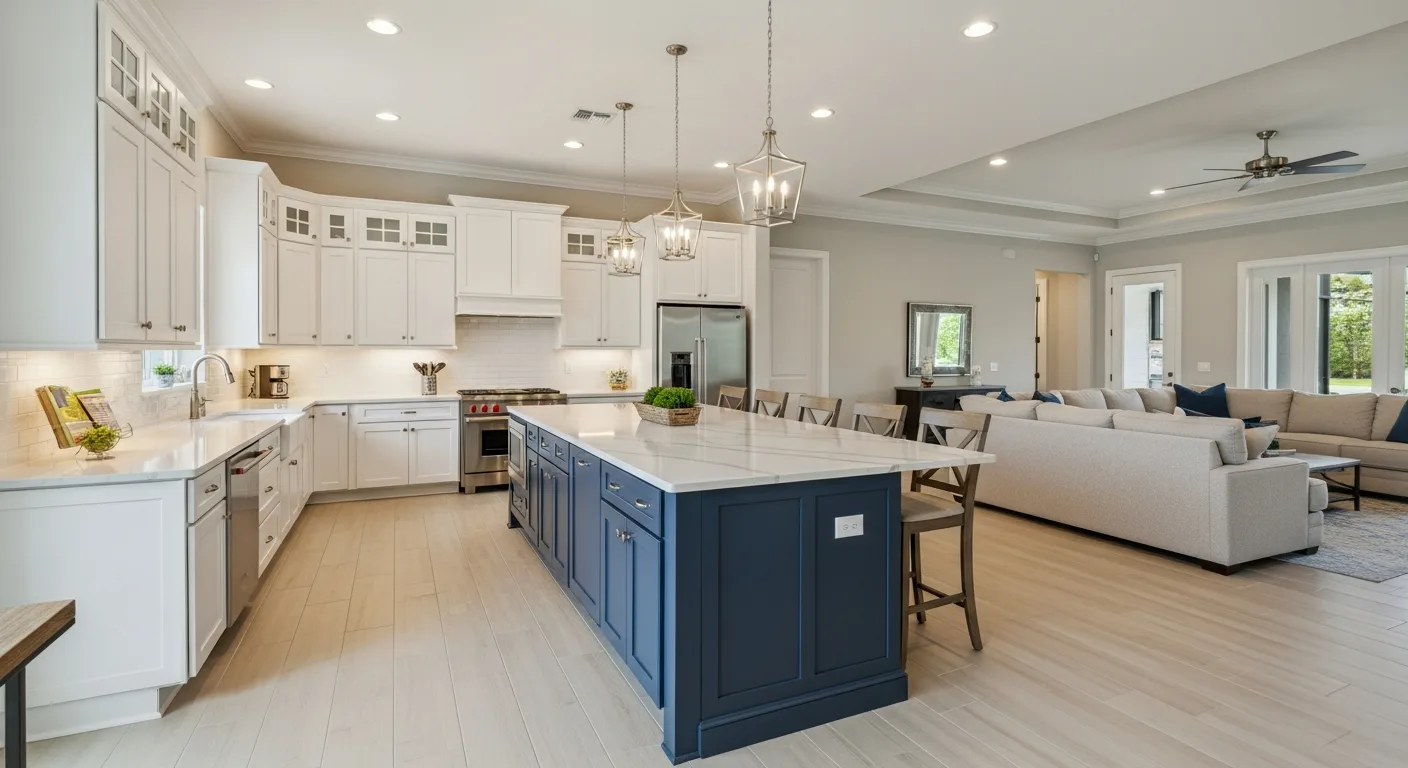
“Open concept” describes a result, not a layout. The specific floor plan you create determines how the kitchen functions, how it relates to the living space, and whether Florida’s heat and cooking smells become a daily problem in a home with no wall to contain them.
| Layout | Best For | Island Required? | FL-Specific Notes |
|---|---|---|---|
| L-shape + island, open to living | Most Florida homes, 1,500–3,000 sq ft | Yes — defines kitchen zone | Island prevents air conditioning loss into open space |
| G-shape / wrap kitchen, open side | Larger homes, active cooks | Optional | Maintains more separation; good for entertaining |
| Galley-open (one wall removed) | Smaller homes, condos | No | Loses some storage; best with peninsula instead of island |
| U-shape + breakfast bar open side | Larger kitchens, families | No — bar replaces island | More enclosed; good if cook wants some separation from guests |
| Full open — kitchen integrated into great room | Luxury, open-plan builds | Always | HVAC load increases significantly; AC zoning may be needed |
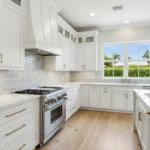
The island is functional zoning in Florida’s open plans. Without a wall to define the kitchen, an island creates a physical boundary between cooking space and living space — guests naturally stay on one side, the cook works on the other. In Florida homes where the kitchen was previously separated by a full wall, removing that wall and adding a 96-inch-plus island is the standard replacement approach.
Cooking smell management in an open plan. Florida cooking habits — seafood, high-heat cooking, year-round entertaining — mean cooking odors travel freely through an open floor plan. A properly sized, ducted range hood rated for your cooktop’s BTU output is non-negotiable in an open concept Florida kitchen. Recirculating hoods that filter and return air are not adequate for open plans. Duct run to exterior: budget $800–$2,500 if the run is longer than 8 feet or needs to turn corners.
Traffic flow in Florida’s entertaining culture. Florida homeowners entertain more year-round than in most US markets — pool access, outdoor living, indoor-outdoor flow. In an open concept kitchen, traffic flow from front entry → kitchen → dining → outdoor access should be unobstructed. Work with your designer to trace the path from front door to back lanai through the kitchen before finalizing the island placement and any remaining cabinetry run.
What Permits Does an Open Concept Kitchen Remodel Require in Florida?
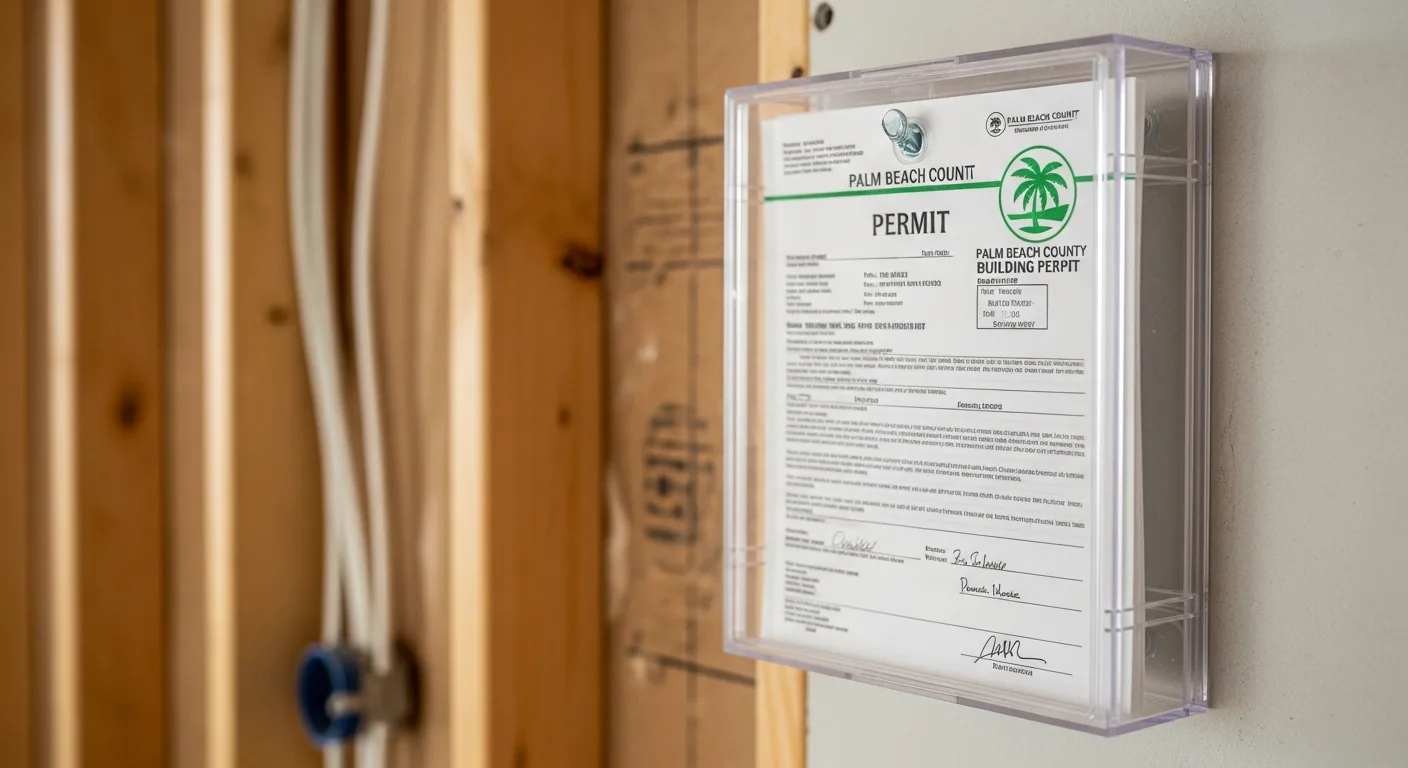
Permit requirements for an open concept kitchen remodel in Florida vary by county and scope — but almost every project that involves wall removal will require at least one permit, and most require two or three.
| Work Scope | Permit Required | Who Pulls It | Typical Fee |
|---|---|---|---|
| Structural wall removal (any county) | Building permit + structural drawings | GC or licensed contractor | $300–$1,200 |
| Electrical work (new circuits, relocation) | Electrical permit | Licensed electrician | $100–$400 |
| Plumbing work (rerouting pipes, new drain) | Plumbing permit | Licensed plumber | $100–$350 |
| Mechanical (HVAC duct work) | Mechanical permit | HVAC contractor | $100–$300 |
| Window/door additions on exterior wall | Building permit | GC or contractor | $200–$600 |
| HVHZ (Miami-Dade, coastal Palm Beach) | All of above + HVHZ product approval | Same trades | Add $200–$500 |
Who pulls permits matters. In Florida, permits are typically pulled by the licensed contractor performing that scope of work — not the homeowner. General contractors handle the building permit. Subcontractors (electrician, plumber, HVAC) pull their respective trade permits. Make sure your contract specifies who is responsible for permit procurement and inspection scheduling.
Inspection checkpoints during the project. A permitted open concept remodel in Palm Beach County typically requires: framing inspection (after wall removal, before drywall), rough electrical/plumbing inspection (before drywall), insulation inspection (if applicable), and final inspection. Missing an inspection means opening walls after drywall — expensive and avoidable.
Unpermitted work and the Florida insurance problem. Florida homeowners’ insurance policies typically exclude claims arising from unpermitted structural work. If a contractor removes a load-bearing wall without a permit and your roof settles two years later, your insurance company will deny the claim. For an open concept kitchen remodel specifically — which is almost always a structural project — unpermitted work is not a risk worth taking.
Per Florida Building Code, any work affecting the structural system, electrical system, mechanical system, or plumbing of a building requires a permit. For the full picture of how permits fit into a project timeline, the week-by-week remodel timeline covers permit scheduling by phase.
How Big Should the Island Be in a Florida Open Concept Kitchen?
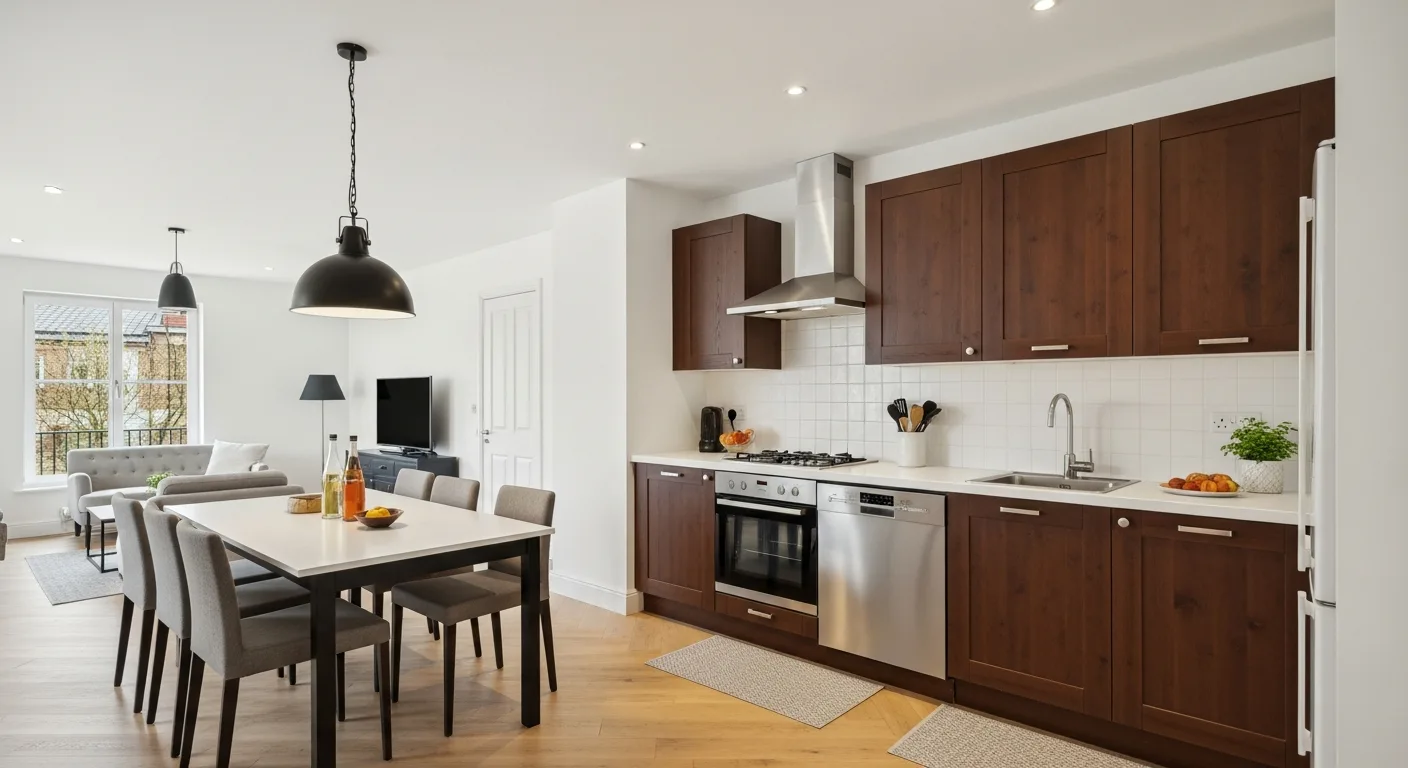
Island sizing in an open concept kitchen is the detail most homeowners get wrong — usually by undersizing. An island that looks generous in a showroom can feel cramped in a real open plan where it needs to function as a cooking surface, seating area, and spatial divider simultaneously.
| Kitchen Footprint | Recommended Island Size | Min. Clearance (per code) | Seating Capacity |
|---|---|---|---|
| Under 150 sq ft | 36″ × 60″–72″ | 42″ work aisle, 36″ seating side | 2–3 stools |
| 150–250 sq ft | 42″ × 84″–96″ | 42″ work aisle, 42″ seating side | 3–4 stools |
| 250–350 sq ft | 42″–48″ × 96″–120″ | 48″ all sides | 4–5 stools |
| 350+ sq ft (open great room) | 48″ × 120″+ | 48″ all sides | 5–6+ stools |
| Luxury / entertaining focus | Custom waterfall, 2-tier | 48″+ all sides | 6+ stools |
42 inches minimum work aisle is Florida code — not a suggestion. The Florida Building Code and NKBA guidelines both require 42 inches of clearance between an island and any wall or appliance run on the work side of the kitchen. For two-cook households, 48 inches is the practical minimum. Violations get flagged at inspection.
Overhang for seating. Bar stools require a 12-inch minimum overhang from the island’s finished edge to the cabinet face. Counter-height seating (36 inches) works better for Florida kitchens that open to an outdoor dining area — it’s easier to transition from indoor bar seating to outdoor dining at the same height. Island height (42 inches) gives more separation between cooking surface and seating.
Waterfall edges in Florida’s open plans. The waterfall island — where the countertop material wraps vertically down one or both sides — is the dominant design choice in Wellington, Palm Beach, and Boca Raton open concept kitchen remodels right now. It reads as high-design from the living room side and protects the island cabinet face from Florida humidity. Quartz is the most practical waterfall material; marble’s porous surface and book-matching requirements make it a premium and high-maintenance choice.
How Does Lighting Work in an Open Concept Florida Kitchen?
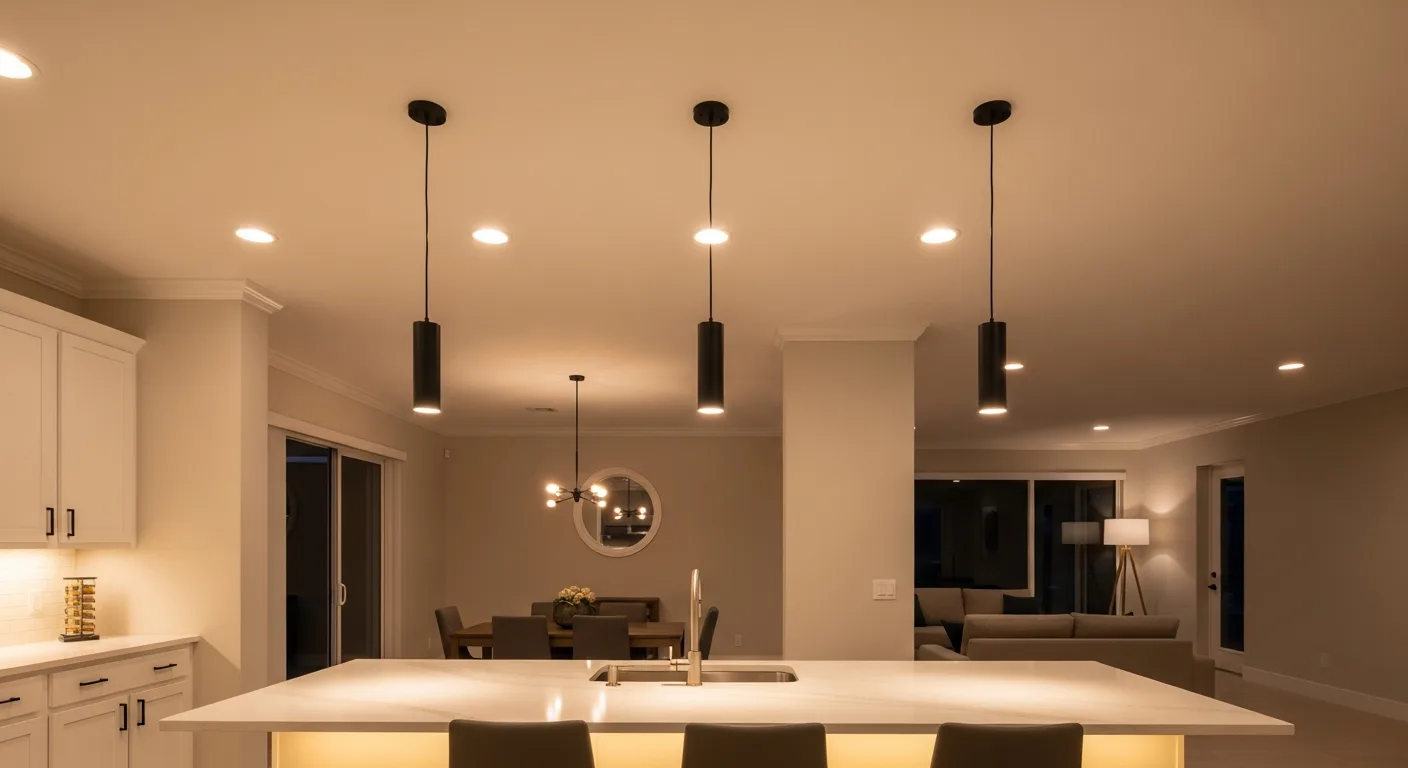
Removing a wall doesn’t just open the space — it removes the ceiling plane transition that previously separated kitchen lighting from living room lighting. In an open concept Florida kitchen, lighting design has to work for two different functions in one continuous ceiling zone.
| Lighting Layer | Kitchen Zone Function | Living Zone Function | Florida Notes |
|---|---|---|---|
| Recessed cans (5″–6″) | Task lighting over counters + prep areas | Ambient fill, dimmed for evening | LED required in FL energy code; 2700K warm white preferred |
| Pendants over island | Task + visual anchor for kitchen zone | Decorative statement visible from living | 30″–36″ above counter; 6″–12″ apart center-to-center |
| Under-cabinet LED | Direct task lighting, shadow-free prep | Not applicable | Battery or hardwired; hardwired during remodel is worth the cost |
| Cove / tray ceiling | Optional accent | Transition marker between zones | Common in FL CBS ceiling construction where tray is structural |
| Dimmable circuits | Essential — cooking vs. entertaining | Essential — TV viewing vs. entertaining | 3-way switches at kitchen entry + living entry |
| Ceiling fan | Air circulation, energy code compliance | Air circulation | FL energy code often requires fan in living zone over certain sq ft |
The lighting transition is your primary zone marker. Without a wall, pendant lighting over the island becomes the visual signal that says “kitchen is here.” Hang pendants too high and the effect disappears into the ceiling. Hang them at 30–34 inches above the island counter — lower than most installers default to — and they define the space.
Florida energy code and recessed lighting. Florida’s energy code (Florida Building Energy Efficiency Standards) requires IC-rated, airtight recessed fixtures in conditioned spaces. If your existing kitchen had non-airtight cans, the permit will trigger an upgrade requirement when you remodel. Plan for it: airtight LED recessed cans cost $15–$35 each versus $8–$15 for non-rated, but avoiding the inspection failure is worth the difference.
Natural light management. Florida’s intense direct sun can make an open concept kitchen glare-heavy in the morning or afternoon depending on orientation. Specify solar shades or UV-filtering window film on kitchen windows — particularly at east-facing windows where morning sun hits the cooktop area — before finalizing the lighting plan. Glare affects how your finished kitchen looks in photos and how comfortable it is to cook in daily.
What Flooring Works Across an Open Concept Space in Florida?
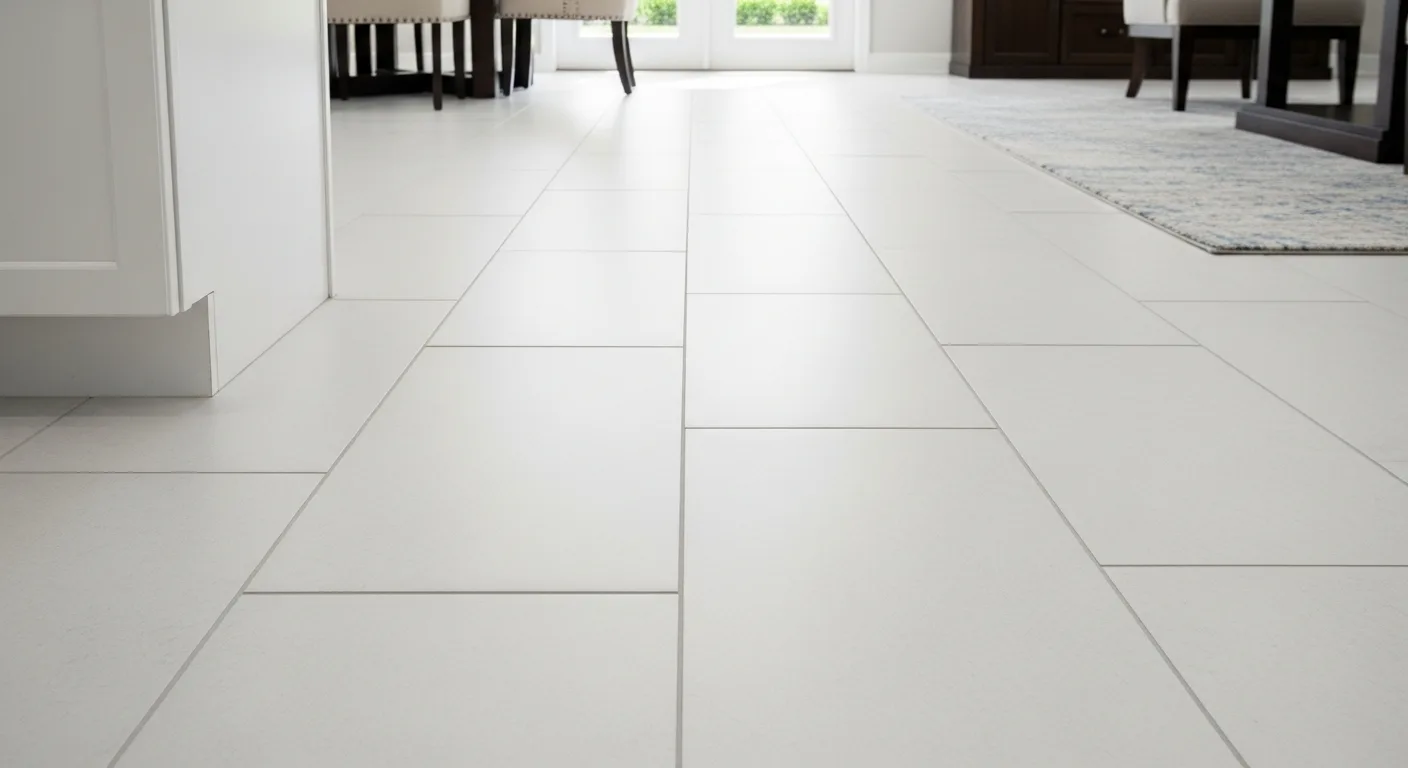
One of the most practical decisions in an open concept kitchen remodel is flooring: whether to run a single material from kitchen through living room, or to transition at a specific point. In Florida, where humidity, foot traffic, and indoor-outdoor living are constants, this decision has functional as well as aesthetic dimensions.
| Flooring Option | Water/Humidity Resistance | Suitable Open-Plan? | Cost Installed FL (per sq ft) | Florida Note |
|---|---|---|---|---|
| Large-format porcelain tile (24″×24″+) | Excellent | Ideal — fewest grout lines | $9–$22 | Most popular FL open-plan choice; cool underfoot in summer |
| Wood-look porcelain plank | Excellent | Ideal | $8–$18 | Hardwood look without moisture risk; fits FL climate perfectly |
| Engineered hardwood | Good — better than solid | Good if floating install | $10–$20 | Avoid in kitchens within 10 ft of coast; salt air accelerates wear |
| Luxury vinyl plank (LVP) | Excellent | Ideal | $5–$12 | Popular in mid-range FL remodels; handles humidity and pets |
| Solid hardwood | Poor — swells, warps | Not recommended | $12–$25 | Not suitable for FL kitchens or open plans in humid zones |
| Polished concrete | Excellent | Good | $8–$18 (seal + polish) | Very FL-appropriate; cool, modern, no joints across open space |
| Small-format tile | Good | Acceptable | $6–$15 | More grout lines = more maintenance in kitchen |
Run one floor through the entire space. The strongest design argument for an open concept Florida kitchen is a single flooring material running continuously from the kitchen through the dining and living areas. Transition strips at doorways that previously existed disappear, the space reads as larger, and resale value is stronger. This requires calculating total square footage before demo — not after.
Grout line width in Florida kitchens. Minimal grout joints (1/16″ to 1/8″) are worth specifying in Florida kitchens. Food and grease trap in wide grout joints, and the humid Florida climate accelerates mold growth in unsealed grout. Large-format tiles naturally minimize joint width. Whatever tile you choose, specify a penetrating grout sealer applied at installation.
Transition from existing flooring in other rooms. If rooms adjacent to the new open space have different existing flooring, you’ll need a transition solution. Options: extend the new flooring into those rooms as part of the remodel scope, use a flush T-molding transition strip, or accept a visual break at each room threshold. Most Florida homeowners completing an open concept remodel extend the new flooring at least into the formal dining and living areas for visual continuity.
HVAC and Air Conditioning in an Open Floor Plan: What Changes
Removing a wall doesn’t just change how the space looks — it changes how air moves through the house. In Florida, where air conditioning accounts for 40–60% of a home’s energy use, getting HVAC right in an open concept remodel is a practical and financial priority.
| HVAC Concern | Closed Kitchen | Open Concept Kitchen | Required Action |
|---|---|---|---|
| Cooling load calculation | Calculated per room | Must recalculate combined open zone | Manual J load calc by HVAC contractor |
| Supply vent location | Optimized for closed room | May need new vents over island or cooking area | Duct modification during remodel |
| Return air | Single return for kitchen | May need additional return for larger zone | HVAC contractor assessment |
| Range hood exhaust | Contained smell in kitchen | Odors travel to living room without adequate CFM | Upgrade to 600 CFM+ range hood, exterior ducted |
| Thermostat placement | Kitchen vs. living room separate | Open zone should have single thermostat in central location | Relocate if previous kitchen thermostat is now in cooking zone |
| AC system capacity | Sized for closed rooms | Larger zone may exceed current system capacity | System sizing review — may need unit upgrade |
| Ceiling fans | Optional | Energy code may require in living zone | Confirm FL energy code requirements for your county |
The Manual J load calculation is not optional. When you remove a wall and combine two previously separate HVAC zones into one larger open space, your existing duct work and air handler may be undersized for the new load. A Manual J load calculation — performed by a licensed HVAC contractor — determines whether your current system can handle the new configuration or whether you need additional supply, a zone controller, or a unit upgrade. This calculation typically costs $150–$400 and can save $2,000–$8,000 in a system upgrade that was incorrectly specified.
Range hood CFM for open concept. In a closed kitchen, a 400 CFM range hood is often sufficient. In an open concept plan where cooking smells travel freely into the living and dining areas, 600–900 CFM is the practical minimum. Sizing the hood correctly during the remodel, when duct runs are already open, is far cheaper than adding CFM capacity after the walls close.
What Does an Open Concept Kitchen Remodel Cost in Florida?
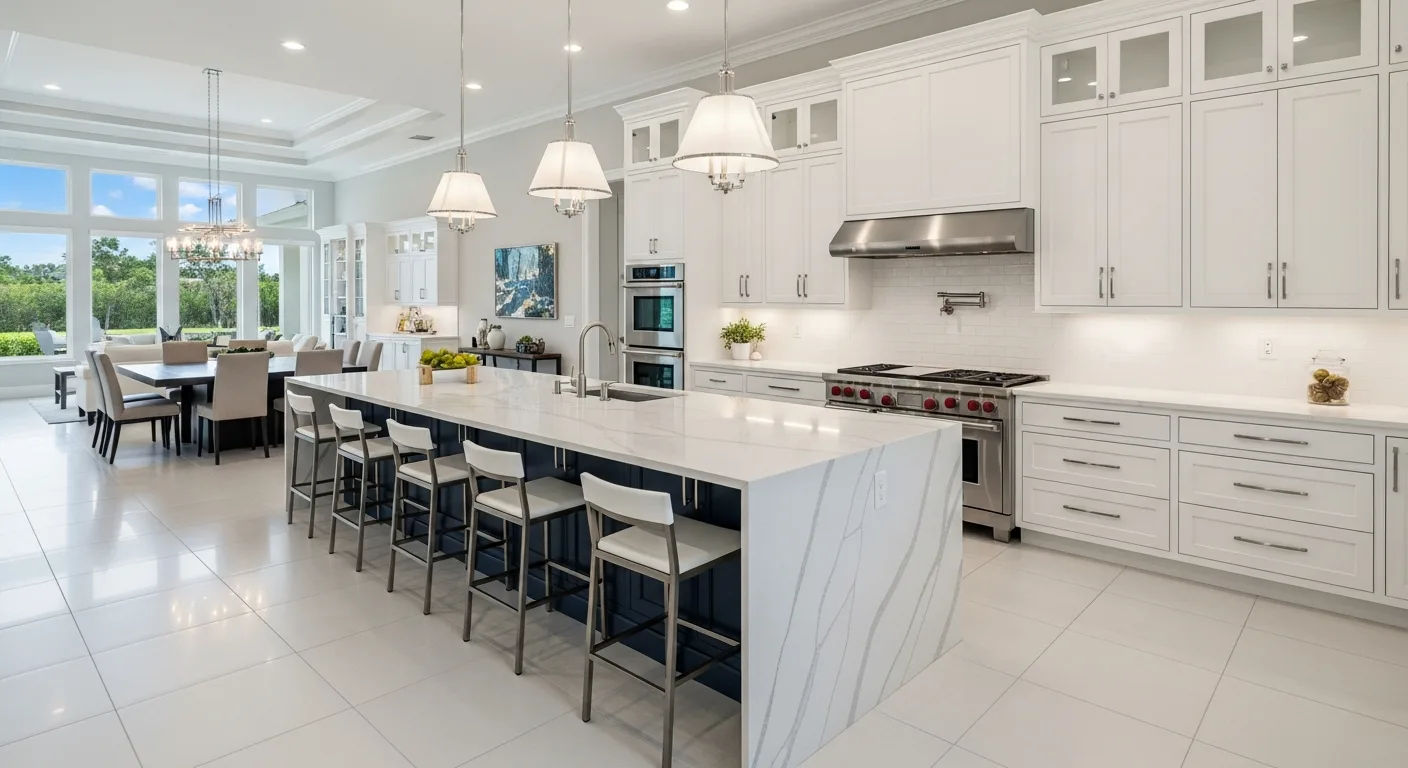
Open concept kitchen remodel costs in Florida vary more than any other kitchen project type because the structural component — wall removal, beam installation, engineer fees — adds a layer of cost that a standard cabinet-and-countertop remodel doesn’t have.
| Project Scope | Typical Total Cost | Key Variables |
|---|---|---|
| Non-load-bearing wall removal + kitchen refresh | $15,000–$35,000 | Wall complexity, cabinet scope, countertops |
| Load-bearing wall removal + mid-range remodel | $45,000–$80,000 | Beam length, cabinet grade, appliance tier, flooring |
| Load-bearing wall removal + high-end remodel | $85,000–$150,000+ | Full custom cabinets, luxury appliances, structural complexity |
| Load-bearing wall + plumbing/electrical rerouting | Add $8,000–$20,000 | Scope of trades work needed |
| Flooring extended through living/dining | Add $4,000–$10,000 | Material grade, square footage |
| HVAC duct modification | Add $1,500–$5,000 | Extent of duct work changes |
| Engineer fee + permit | Add $800–$2,000 | County, project complexity |
The structural work is typically 15–25% of total project cost. On a $65,000 open concept kitchen remodel, the beam, posts, engineer fee, structural framing, and drywall repair might run $10,000–$15,000. The remaining 75–85% is kitchen renovation — cabinets, countertops, appliances, flooring, lighting. Understanding this split helps when comparing quotes: a contractor who gives a low number on the structural work is either cutting corners on the beam spec or planning a change order.
South Florida premium. Labor rates in Palm Beach County and Broward run 15–25% higher than Central Florida for the same scope. A Wellington kitchen remodel with an open concept conversion in the $55,000–$75,000 range and a comparable project in Orlando might be quoted at $45,000–$60,000 — same materials, same scope, different market.
Itemized quote requirement. Get separate line items for: structural engineering, wall demo + framing, beam + posts (including material grade — LVL vs. steel), all trade work (electrical, plumbing, HVAC), cabinets, countertops, appliances, flooring, lighting, and permits. Any quote that bundles these categories makes cost comparison impossible. For a full breakdown of kitchen cost line items, the kitchen remodel cost in Florida guide covers each category in detail.
FAQ
Does removing a wall for an open concept kitchen always require a permit in Florida? If the wall is load-bearing, yes — always. A structural permit is required in every Florida county. For non-load-bearing walls, the permit requirement depends on whether the work touches electrical, plumbing, or mechanical systems inside the wall. In practice, most open concept kitchen projects involve at least electrical work, which triggers a permit. The safest approach is to permit everything — unpermitted structural work creates serious problems at resale and with homeowner’s insurance claims.
How do I know if my kitchen wall is load-bearing without opening it? Look for these indicators: the wall runs perpendicular to floor joists (visible in attic or basement), it sits directly above a foundation beam or bearing wall below, it has a double top plate, or it aligns with a ridge beam above. None of these are conclusive on their own — a licensed structural engineer can confirm load-bearing status with a site visit for $400–$800. Don’t guess on this.
Will opening my kitchen to the living room increase my electric bill in Florida? Potentially, yes — but only if your HVAC system isn’t properly adjusted for the larger combined zone. A Manual J recalculation after the remodel ensures your system is sized correctly. With proper HVAC planning, most Florida homeowners see minimal change in energy costs. A larger, better-ventilated space with proper ceiling fans and shade management can sometimes be more efficient than a closed, stuffy kitchen.
What’s the best island size for a Florida open concept kitchen? For most Florida homes in the 1,800–3,000 sq ft range, a 42–48 inch wide by 96–108 inch long island is the sweet spot. It provides enough workspace for cooking, adequate bar seating for 3–4 people, and sufficient clearance on all sides without dominating the space. In larger homes — think Palm Beach kitchen projects — islands run 10–12 feet long and often include two-tier heights (prep surface + bar height).
How long does an open concept kitchen remodel take in Florida? Timeline depends on whether the wall is load-bearing and whether trades work is needed. A non-load-bearing wall removal with a full kitchen renovation: 6–10 weeks. A load-bearing wall project with beam installation, full trades work, and a mid-range kitchen renovation: 12–18 weeks (including the 6–8 week semi-custom cabinet lead time). High-end custom cabinetry pushes that to 20–28 weeks. Factor permit processing time (typically 2–6 weeks in Palm Beach County) on top of construction time.
Should I do an open concept remodel before listing my Florida home? Generally yes — with conditions. Open concept layouts command a resale premium in Florida markets, particularly in homes built before 1990 when closed floor plans were standard. The ROI is strongest when the project includes a full kitchen renovation alongside the structural work. A wall removal with budget finishes returns less than a comprehensive remodel. Consult with a local real estate agent before deciding — in some neighborhoods, the market already expects open concept, and the project simply brings you to parity rather than generating a premium.
Does an open concept kitchen affect homeowner’s insurance in Florida? The structural change itself doesn’t directly affect premiums, but it must be permitted and inspected to maintain insurance validity. Unpermitted structural work — load-bearing wall removal without permits — is typically excluded from coverage under Florida homeowner’s policies. After the project, update your home’s replacement cost estimate with your insurer, since a major remodel changes the rebuild value.
Open Up Your Space with Confidence
An open concept kitchen remodel in Florida is one of the highest-impact changes you can make to how your home feels and functions — but it requires getting the structural, mechanical, and design details right. Done well, it transforms a home. Done carelessly, it creates problems that take years to surface.
RenoVision works with Florida homeowners from Palm Beach County through South Florida on open concept projects of every scope — from single-wall removals to full great room conversions. Tell us what you’re working with and we’ll tell you what’s actually possible.